Operational AI Solutions
Driving Mammography Screening Efficiencies and Workflows
.png?width=2000&height=1545&name=Precise%20Positioning%20%20Reliable%20Density%20%20Personalized%20Risk%20(10).png)
Visit Us at RSNA 2025
November 30 - December 3 McCormick Place, Chicago, IL
Booth 2806, South Hall Level 3
.png)
Events at RSNA

With Densitas®, you don't just improve quality, you drive sustainable growth, personalized care pathways, and cement your leadership in breast health care.
.png)
.png)
Compliance Burden to Continuous Quality Improvement
Maintaining MQSA EQUIP compliance and ACR accreditation consumes valuable team time, slows operations, impacting the patient experience, and contributing to burnout among radiologists and technologists.
"What Gets Measured Gets Managed"
This principle guides the American College of Radiology Learning Network's (ACRLN) Mammography Positioning Improvement Collaborative framework for continuous quality improvement (CQI). The ACRLN collaborative showed significant improvements in mammogram positioning quality by measuring performance, setting goals, and implementing interventions.

Learn how to transform your mammography practice into a model of efficiency, continuous quality improvement, clinical excellence and sustainable growth that fosters patient trust.

.jpg?width=2000&height=1297&name=iStock-1181392437%20(2).jpg)
See IntelliMammo in Action. Discover how a leading radiology group cut EQUIP review time by 90% with IntelliMammo.
In the fast-paced world of modern radiology, efficiency isn't luxury — it's an imperative. As a leading radiology practice with over 20 mammography facilities across New Jersey, University Radiology Group (URG) faces constant pressure to maintain the highest standards of care delivery while complying with stringent demands of the FDA's MQSA and ACR accreditation protocols.
.png)
Breast density assessment is integral to breast cancer screening and risk evaluation. However, positioning errors in mammography can lead to misinterpretation of dense tissue.
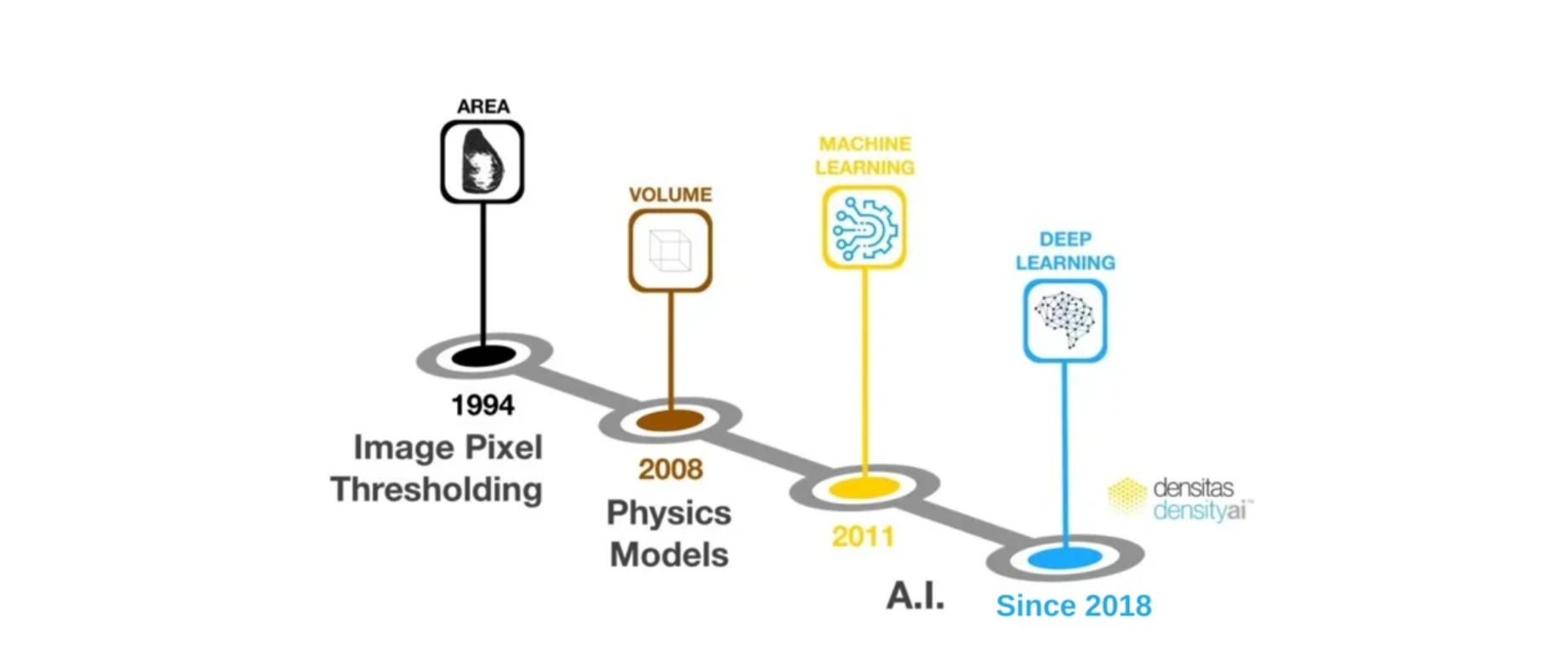
Densitas’ densityAI™ deep learning algorithm is based on the latest BI-RADS Atlas breast composition classification guidelines and considers pixel intensity, texture and distribution. Density results have been rigorously validated for face-validity and have demonstrated almost perfect agreement with expert radiologist consensus.

.png?width=2000&height=650&name=rsna%20landing%20page%20graphics%20(4000%20x%201300%20px).png)

Scalable High-Risk Breast Cancer Management with intelliRisk™
IntelliRisk™ enables healthcare providers to assess, identify, and manage high risk patients efficiently and effectively. By incorporating established clinical guidelines, advanced short-term and long-term breast cancer risk models, and best practices, it supports informed decision-making across the entire breast health pathway.
- Streamline breast cancer risk assessments
- Improve high-risk patient identification for personalized screening protocols
- Boost patient engagement and compliance
- Optimize follow-up care coordination
- Enable scalable high-risk program management

The Economics
of High-Risk Clinics
Healthcare leaders across the spectrum – service line managers, CMOs, CIOs, large health systems, Integrated Delivery Network, and private radiology groups – are increasingly recognizing the pivotal role of high-risk breast cancer clinics. Once considered a niche concept, these specialized programs are quickly becoming a standard component of comprehensive breast care. The big question for administrators and executives is clear: How do high-risk clinics financially justify themselves while improving patient outcomes?
.png?width=2000&height=1125&name=Quality%20Fatigue%20(30).png)
News
[NYC, New York] – October 14, 2025 – Densitas has qualified for the American College of Radiology® (ACR®) Learning Network Vendor Partner designation. Through the ACR ImPower Mammography Positioning Improvement Collaborative, Densitas and the Mount Sinai Health System worked side-by-side to identify and address sources of positioning variation that can compromise image quality and breast cancer detection.
HALIFAX, NS, July 9, 2025 – Results of a groundbreaking multicenter study involving 126,367 mammograms show that the use of artificial intelligence (AI) to evaluate mammography positioning on digital screening mammograms provides mammography positioning quality (MPQ) tracking at scale that reveals persistent unmet MPQ criteria across two major U.S. health systems.